Central Africa
CMUSphinx4 Speech recognition toolkit
Submitted by Shadrack on Tue, 2012-12-18 10:18This is one of the appropriate tools to work on if interested in building a speech recognizer, challenges though few include building a corpus for the dialect chosen.I attained 72% recognition on a set of isolated utterances in swahili dialect. If in need of assistance with the tool, Ill be glad to help.
Shadrack
- Login to post comments
Cilubà Part-of-Speech Tagger - Demo
Submitted by Guy on Fri, 2012-03-02 10:55This demo showcases a part-of-speech tagger for Cilubà. It retrieves the morpho-syntactic categories for words in a sentence.
Type in the text you want to tag
Example: Kiipàcìlà kàà kumpàlà kàà mukàndà eu ǹkwambulwisha eu yônso udi ulonga cilubà nè ukààdi mudbìdìje nè nsùùlakajilu wacì.
- Login to post comments
Third Workshop on African Language Technology (AfLaT 2011) - Report
Submitted by Guy on Fri, 2011-12-09 08:43| AfLaT2011, the Third Workshop on African Language Technology, was organized as a breakout session of the AGIS11 conference (Action Week for Global Information Sharing) in Addis Ababa, Ethiopia. It marked the first time an AfLaT workshop took place on the African continent. AfLaT2011 featured ten presentations on a variety of topics and languages. We want to thank the presenters and participants for their contributions to the workshop, as well as the organizers of AGIS11 to allow us to collocate the AfLaT workshop with their wonderful conference. | 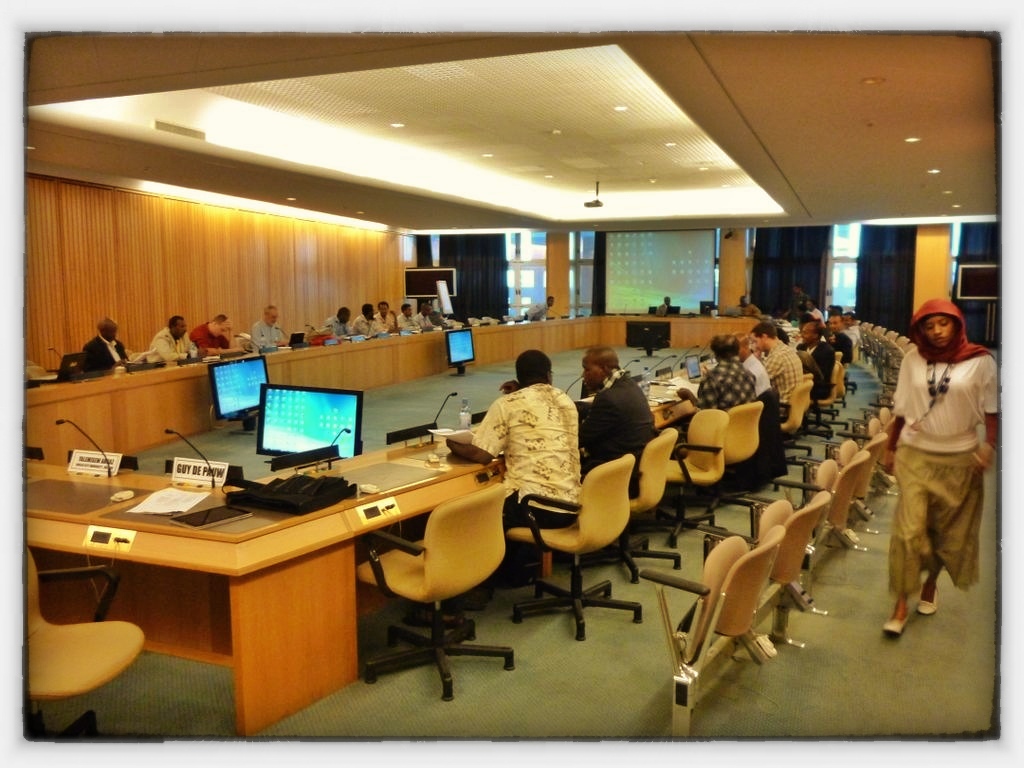 |
Second Workshop on African Language Technology (AfLaT 2010) - Report
Submitted by Guy on Thu, 2010-08-05 08:33Invited Talk: Do we need linguistic knowledge for speech technology applications in African languages? | |
|---|---|
Justus Roux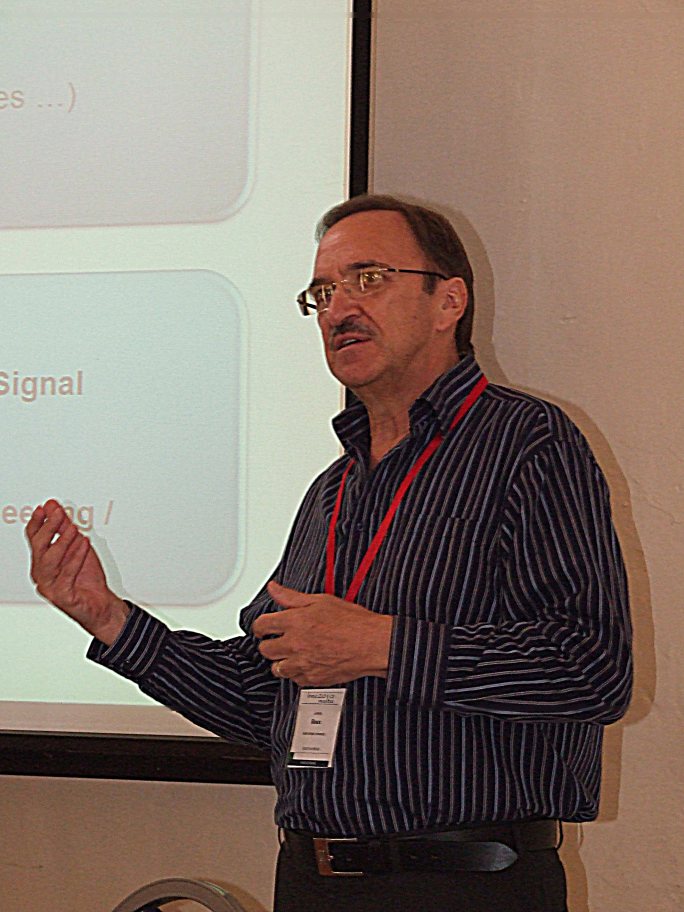 | |
Martin Benjamin and Kevin Scannell on localisation and Central African languages
Submitted by Guy on Fri, 2010-04-23 06:45Podcast on localisation and Central African languages
- Login to post comments
Newsletter October 2009
Submitted by Guy on Mon, 2009-10-19 14:48Dear AfLaT member,
we would like to draw your attention to some recent highlights in African Language Technology.
(1) Google announced the availability of their Swahili Machine Translation system
https://aflat.org/?q=node/346
(2) CALL FOR ABSTRACTS for the National Human Language Technology Network Day 2010
https://aflat.org/?q=node/345
(3) MURI Call for White Papers: "Structured Modeling for Low-Density Languages"
https://aflat.org/?q=node/347
Also several new publications and links have recently been added. We hope to see you soon at https://AfLaT.org!
with kind regards
the AfLaT team
- Login to post comments
Funding opportunity: MURI Call for White Papers
Submitted by Guy on Mon, 2009-10-19 14:14Funding opportunity: MURI Call for White Papers, DUE Dec 11
BROAD AGENCY ANNOUNCEMENT (BAA)
Call for White Papers
DEADLINE: Dec. 11, 2009
Multidisciplinary University Research Initiative (MURI)
topic # 25: "Structured Modeling for Low-Density Languages"
Lingala Diacritic Correction
Submitted by Guy on Mon, 2009-04-27 12:45The problem with using web texts for many languages is that many people do not have the ability to enter diacritics or characters from extended
character sets from their keyboard, and so they simply leave them off (and so Lingala "likɔngá" becomes "likonga"), or use incorrect diacritics
(e.g. using acute/grave in place of the macron in Hawaiian, Maori, etc.). Information is usually lost in this conversion, and indeed most languages
that use diacritics have many pairs of words that differ only in diacritical marks; these distinctions are lost when texts are written in plain ASCII.
The aim of charlifter is to undo this lossy conversion, and "lift" the text back to its proper form.
- Login to post comments
Web Site Flore
Submitted by Enguehard on Mon, 2008-11-03 16:52This web site present the name of African trees in different languages.
Today there are 375 names, 17 languages.
The language of communication is French, but browing is very simple.
- Login to post comments
Unicode-Afrique
Submitted by donosborn on Sun, 2008-03-16 02:19Unicode-Afrique est un forum sur Yahoogroupes. Il existe pour : donner publicité aux projets en Afrique utilisant l'Unicode; discuter des questions et problèmes pratiques avec Unicode et les jeux de caractères pour les langues africaines; et partager des expériences utiles sur le développement et utilisation des polices unicodes pour les langues africaines. Cet e-groupe fait partie d'une "famille" de forums de discussion sur la rencontre des langues africaines et NTIC (les autres forums sont accessibles à la page portail "A12n," dont le lien se trouve au fond de cette page).
- Login to post comments